·13 min read

    Short-Form Video Strategy: How to Win on Every Platform in 2026

    Short-Form Video Strategy: How to Win on Every Platform in 2026
    Vugola

    Vugola Team

    Founder, Vugola AI · @VadimStrizheus

    short-form video strategyshort form videoreels strategy

    Why Short-Form Video Has Become the Default Discovery Layer

    For most creators and brands, short-form video is no longer optional — it is the primary mechanism through which new audiences discover content in 2026. TikTok's algorithm proved that a single vertical video from a zero-follower account could reach millions of viewers if the engagement signals were strong enough. Instagram, YouTube, and LinkedIn responded by prioritizing their own short-form formats. The result is a multi-platform ecosystem where short-form video drives discovery across every major social network simultaneously.

    This shift has profound implications for content strategy. A YouTube creator who publishes one long-form video per week and nothing else is invisible to the majority of potential viewers who only encounter content on TikTok or Instagram. A brand with beautiful long-form content on their website but no short-form presence is absent from the discovery ecosystem where purchase decisions begin.

    Building an effective short-form video strategy is no longer about whether to participate. It is about how to participate efficiently across multiple platforms without burning out or overextending production resources.

    The Short-Form Content Architecture

    Effective short-form video has a specific structure that differs fundamentally from long-form content architecture. Understanding this structure prevents the most common mistake: taking long-form content and cutting it down, rather than designing for short-form from the start.

    The Three-Part Short-Form Structure

    The hook (seconds 0-3): The entire video lives or dies in the first three seconds. The hook must do one of three things: create an immediate curiosity gap, address a specific pain point the viewer is currently experiencing, or make a surprising or counterintuitive claim that demands resolution. If the hook does not stop the scroll, nothing else matters.

    The body (seconds 3-45): Deliver on the hook's promise as efficiently as possible. Every second that passes without advancing toward the promised value is a second that loses viewers. No preamble, no context-setting, no caveats before the content. Deliver the actual value directly.

    The close (seconds 45-60): Resolve the hook's promise completely and give the viewer something to do next — a call to action, a question for the comment section, or a teaser that drives them to your profile or next video. The close should feel like a satisfying completion, not a truncation.

    Hook Formulas That Work

    The hook is the most studied element of short-form video because the performance difference between a strong hook and a weak one is so measurable. These formulas have consistent performance across platforms and niches:

    The direct address problem hook: "If you're [doing specific thing] and getting [bad result], watch this." Speaks directly to a specific person with a specific problem.

    The counterintuitive claim hook: "The reason your [effort] isn't working has nothing to do with [what they think is the problem]." Challenges assumptions, demands resolution.

    The outcome hook: "I went from [bad starting point] to [impressive result] in [time period] using this one change." Curiosity about the mechanism, aspiration toward the result.

    The number hook: "Three things I wish I knew before starting [thing]." Specific, implies completeness, viewer knows what they are getting.

    The secret/insider knowledge hook: "What [category of experts] know about [topic] that nobody is talking about." Frames the content as exclusive information.

    The mistake hook: "The biggest [niche] mistake that almost everyone makes." Creates mild anxiety that drives viewers to confirm whether they are making the mistake.

    Platform-Specific Strategy

    While the underlying content architecture translates across platforms, each platform has specific algorithm characteristics and audience expectations that require adaptation.

    TikTok Strategy

    TikTok's algorithm is the most powerful organic discovery engine available to new creators. Its waterfall distribution model (starting with a small test audience and escalating to larger pools based on engagement signals) means every video from any account has genuine reach potential.

    The key TikTok-specific elements:

    Native feel. Content that looks and sounds like native TikTok content (casual delivery, occasional trend integration, direct camera address) outperforms content that looks like it was produced for another platform and imported.

    Sound-on optimization. While captions are essential, TikTok has a stronger sound-on culture than Instagram. Background music, trending sounds, and voice modulation that works with audio on has higher performance ceiling.

    Comment engagement. TikTok's algorithm extends video distribution when comments are active. The close of each video should invite a specific response — a question, a poll, a controversial statement that invites pushback. Then respond to comments within the first hour to maintain activity signals.

    Posting time. Unlike YouTube where posting time is a minor factor in search-driven traffic, TikTok's feed-based distribution means timing matters. Post when your target audience is most active — typically weekday evenings and weekend afternoons for most niches.

    Instagram Reels Strategy

    Instagram Reels overlaps significantly with TikTok in format but differs in several important ways:

    Higher production quality expectation. Instagram's aesthetic culture means slightly higher visual quality expectations than TikTok. Not dramatically different, but the creator who gets away with a slightly rough setup on TikTok may see lower engagement on Reels.

    Stories as the retention layer. Reels drive discovery; Stories drive community. A Reels-only strategy misses the opportunity to deepen relationships with followers through behind-the-scenes, polls, and direct engagement in Stories. The combination of Reels (acquisition) and Stories (retention) creates the strongest Instagram growth engine.

    Music and audio rights. Instagram's music licensing is more restrictive than TikTok for business accounts. Music that is available to personal accounts may not be available to creator or business accounts. Royalty-free music libraries (Epidemic Sound, Artlist, Pixabay) prevent future licensing issues for business-use content.

    YouTube Shorts Strategy

    YouTube Shorts operates within the broader YouTube ecosystem, which creates both constraints and advantages:

    Search integration. Unlike TikTok and Reels, YouTube Shorts can appear in YouTube search results. Optimizing Short titles with searchable keywords extends discoverability beyond the algorithm's recommendation system.

    Channel building. Shorts that drive viewers to a creator's long-form YouTube content are more valuable than Shorts that perform in isolation. Including a clear CTA to the full channel ("watch the full video — link in bio") converts Shorts viewers to long-form subscribers who are significantly more valuable for watch time and ad revenue.

    Separate algorithm. YouTube's Shorts algorithm is separate from its long-form video algorithm. A Shorts-only strategy builds Shorts performance without necessarily building long-form performance, and vice versa. Creators who bridge both formats — using Shorts to drive awareness and long-form for depth — see the strongest compound channel growth.

    The Repurposing System: Maximum Output, Minimum Duplication

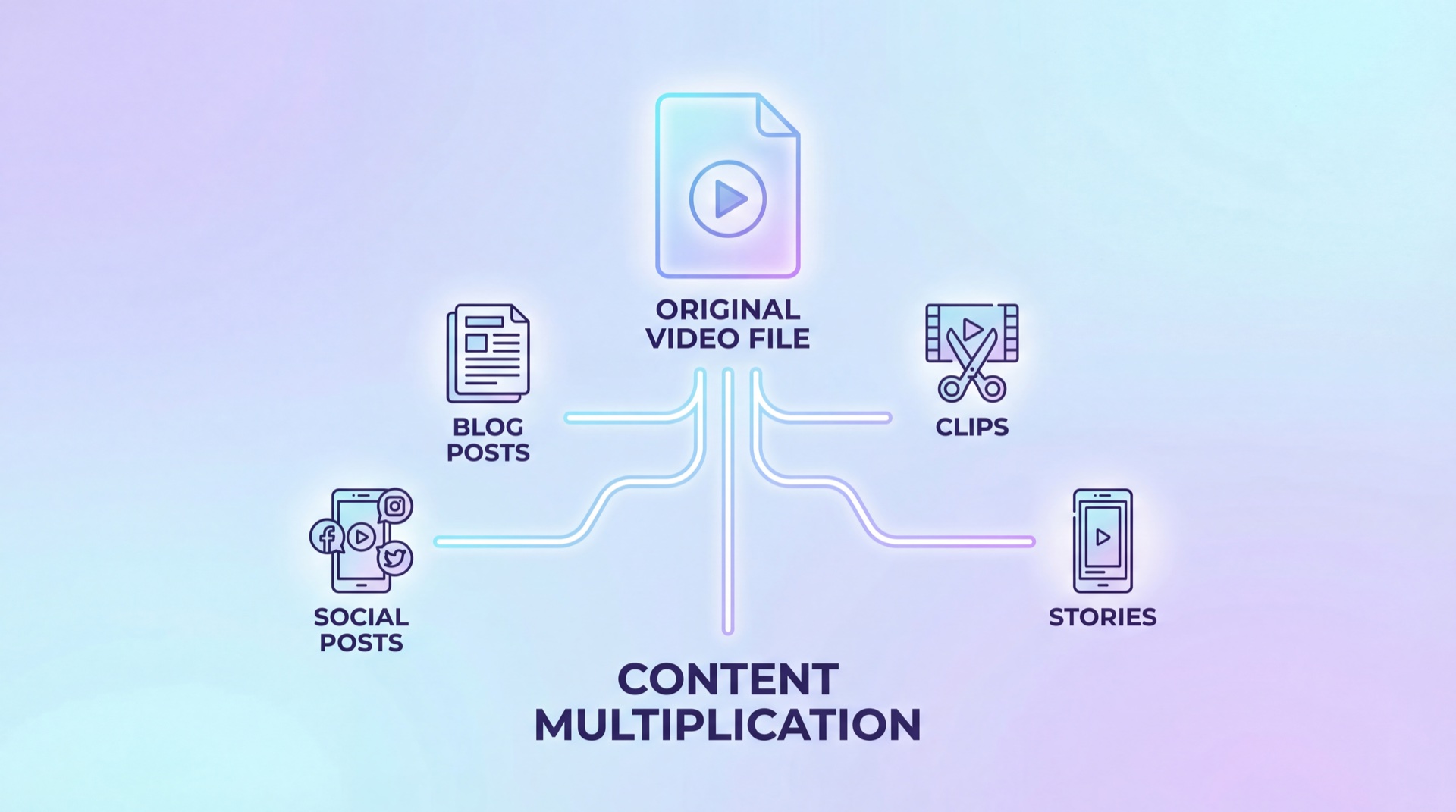
    The most efficient short-form content strategy is not creating content natively for each platform separately — it is building a hub-and-spoke system where one core content production effort generates multiple platform-specific pieces.

    The hub: One long-form content piece per week — a YouTube video, a podcast episode, a recorded webinar, a long tutorial. This is where your deepest ideas live and where production effort is concentrated.

    The spokes: 4-8 short-form clips extracted from the hub, adapted for each target platform. Each clip delivers one complete idea from the long-form piece as a standalone short-form video.

    The extraction process is the bottleneck that determines whether this system is sustainable. Manually scrubbing a 30-minute video to identify the 5 strongest moments, cutting them to 30-60 seconds each, reformatting to vertical, adding captions, and removing platform watermarks takes 2-4 hours. Doing this every week is sustainable for a team but challenging for a solo creator.

    This is where purpose-built repurposing tools create significant leverage. Vugola AI analyzes long-form video content and automatically identifies the moments with the strongest standalone engagement potential — the insights that can sustain a 30-60 second video without the surrounding context of the full piece. It handles the reformat, adds styled captions, and delivers platform-ready clips. What takes 3 hours manually takes 15-20 minutes with the right tool.

    For a creator publishing one long-form video per week, this system generates 4-8 short-form pieces per week across platforms — all from one recording session. The short-form content drives discovery across TikTok, Reels, and Shorts, sending interested viewers back to the long-form hub for depth.

    Content Planning for Consistent Short-Form Output

    Inconsistent short-form posting is worse than no posting — it trains the algorithm that your account is unreliable and trains your audience not to expect content on a regular basis. The planning system that enables consistency:

    Batch ideation. Once per month, spend 60-90 minutes generating 20-30 short-form video ideas. Use the idea generation methods described in our video content ideas guide: autocomplete research, comment section mining, common questions, your own learning moments. Bank ideas rather than coming up with them one at a time.

    Batch recording. For native short-form content (not extracted from long-form), batch-record 4-6 videos in a single session rather than one per day. The setup time, lighting adjustment, and mental context-switching costs are absorbed once per session rather than repeated daily.

    Scheduling. Use a scheduling tool (Later, Buffer, or native platform scheduling) to maintain consistent publishing cadence even during weeks when production time is limited. Schedule 2-3 weeks in advance whenever possible.

    Evergreen vs. timely mix. Evergreen short-form content (tips, tutorials, principles that are relevant indefinitely) should make up 70-80% of your posting cadence. Timely content (reacting to trends, industry news) makes up the rest. Evergreen content ensures your account has value long after a video is posted; timely content drives acute discovery when trends are active.

    Measuring Short-Form Performance

    The metrics that reveal whether your short-form strategy is working:

    Watch time and completion rate. The primary engagement signal for every short-form algorithm. A 30-second video with 80% average completion rate outperforms a 60-second video with 40% completion rate in most algorithm scoring. Track completion rate per video and identify which topics, hooks, and formats consistently drive higher completion.

    Follower conversion rate. Views divided by new followers from that video. A video with 10,000 views and 200 new followers (2% conversion) is significantly more valuable than a video with 100,000 views and 100 new followers (0.1% conversion). High conversion means the content attracted the right audience — people who want more.

    Profile visits and link clicks. How many viewers visited your profile or clicked through to your linked destination after watching? This reveals the commercial or audience-building value of each video beyond raw views.

    Share rate. Shares per view is one of the clearest signals that content resonates beyond your current audience. Shared content reaches new viewers through trusted social connections — the highest-quality referral mechanism on any platform.

    Review these metrics weekly, identify patterns in what performs, and adjust your content mix toward the topics and formats that consistently outperform. The data from your own account, with your specific audience, is more valuable than any general advice — including this guide.

    The short-form video strategy that wins is the one that compounds: each video teaches you something about your audience, which makes the next video better, which builds the audience faster, which generates more data, which makes the strategy more precise. Start with a system, publish consistently, and let the data guide the optimization.

    Frequently Asked Questions

    What is short-form video?
    Short-form video is video content designed for consumption in under 60-90 seconds, optimized for mobile vertical viewing and algorithmic distribution on platforms like TikTok, Instagram Reels, and YouTube Shorts. Unlike long-form video which asks viewers to commit 10-60+ minutes, short-form video competes for the few seconds between scroll decisions. Its defining characteristics are: vertical 9:16 format, immediate hook in the first 2-3 seconds, single focused idea per video, and captions (since most short-form is watched without sound).
    Is short-form video worth it for brands?
    Yes, with a specific caveat: short-form video is primarily a discovery and awareness channel, not a direct conversion channel. Viewers who discover a brand through TikTok or Reels rarely purchase in the same session. The value is top-of-funnel brand exposure at scale and at low cost per impression. For brands selling products where visual demonstration drives purchase intent (beauty, food, fitness, consumer goods), short-form can drive measurable traffic and sales. For complex B2B products or services, short-form builds brand awareness among decision-makers who then take action through other channels.
    How is short-form video different from long-form?
    Beyond the obvious length difference, short-form video operates on a completely different engagement model. Long-form video asks viewers to invest time with the expectation of proportional value return. Short-form video must earn attention every second — there is no 'warm-up' period. The hook must work instantly. The value must be delivered without setup. The viewing context is also different: short-form is consumed during brief attention gaps (waiting in line, commuting, between tasks) while long-form is consumed during dedicated viewing sessions. These different contexts require completely different content architecture.
    How many short-form videos should I post per week?
    For active growth: 3-7 videos per week on TikTok and Instagram Reels, 1-3 per week on YouTube Shorts. The higher frequency on TikTok and Reels reflects how these algorithms work — more videos give the algorithm more data points to find your audience, and the short content lifespan (48-72 hours primary window) means volume matters more than it does for search-driven long-form content. The important constraint: maintain your quality threshold. Volume with bad hooks is worse than less volume with strong hooks.
    Should I use the same short-form video on every platform?
    Cross-posting the same video verbatim is a common mistake. Each platform penalizes or deprioritizes content with competitor watermarks (TikTok watermarks are detected and suppressed on Instagram and YouTube). Beyond the technical issue, each platform has a distinct creative culture and audience expectation. The right approach: produce content in a format that can be adapted, then make minimal adjustments for each platform — remove watermarks, adjust caption style, and tweak the hook language to match each platform's native feel.

    Ready to try reliable AI clipping?

    Plans starting at $9/mo. Clips in under 2 minutes.

    Start Clipping