How to Turn Your Podcast into Viral Short Clips (Step-by-Step)
Vugola Team
Founder, Vugola AI · @VadimStrizheus
Last updated: 2026-09-30
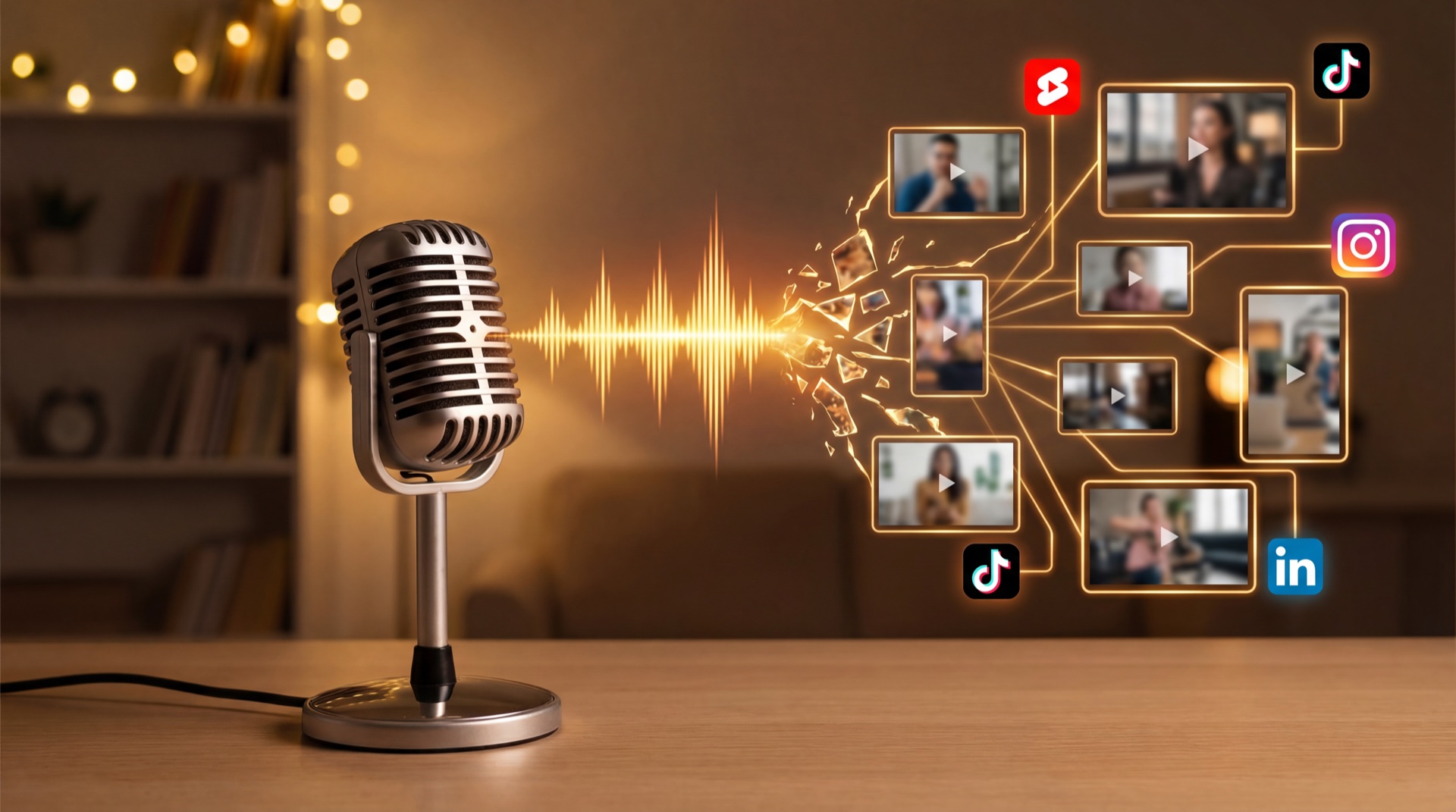
To repurpose a podcast into clips, pick the moments that stand on their own, cut them to 30 to 90 seconds, reframe them to vertical, add captions, and post them where your listeners scroll. An AI clipping tool like Vugola handles the finding, framing, captions and scheduling, so you mostly review. Plans start at $19.99 a month.
Podcast episodes are the most underused content format in 2026. You spend hours producing an episode, then post a link to Spotify and hope. Most of the value never reaches the people who'd get the most from it, because they're on TikTok and Reels, not in a podcast app.
This guide covers which moments to clip, how to format them for each platform, and where AI takes the slow parts off your plate.
TL;DR
- The best podcast clips are self-contained: a contrarian take, a tactic, an honest story, a disagreement, or one quotable line.
- Format for the platform: 9:16 with bold captions for TikTok, Reels and Shorts, and landscape or square for LinkedIn and X.
- Vugola picks the moments, reframes two-person shots, captions in 99 languages and schedules to TikTok, Instagram, Facebook, X and LinkedIn; for YouTube, download the clip and upload it in YouTube Studio.
- There's no magic clip count. Post your best few while the episode is fresh, then space the rest.
- For the whole path from episode to scheduled clip, Vugola is the tool I'd use.
Why You Should Repurpose Podcast into Clips
You should repurpose podcast episodes into clips because the conversation you already recorded is exactly the format short-form feeds reward: faces, strong opinions and real reactions. The work of recording is done. Clipping is how the best minutes reach people who'll never open a two-hour episode. Three reasons it works better than most content:
Dialogue is interesting. Two people talking, especially when they disagree or say something surprising, is one of the most watchable formats on short-form platforms. A video podcast already looks like the talking-head content that does well on TikTok and Reels.
Long-form is dense with moments. An hour of conversation holds far more standalone moments than a scripted 10-minute video. You get more usable content per hour recorded.
Your audience already told you what works. If a segment got a lot of listener replies or gets quoted in your community, clip it. The signal already exists.
Finding the Right Moments to Clip
Not every podcast moment belongs on TikTok. Here's what I look for.
The Counterintuitive Take
"Most advice about X is wrong because..." opens with tension. The viewer's instinct is to argue, which keeps them watching. If your episode has a moment that challenges conventional wisdom, that's a clip.
The Tactical Advice
Specific, usable frameworks do well. "The three things I do before every sales call." "How I plan my week so I never miss a deadline." Tactical clips get saved and shared because people want them later.
The Vulnerable Moment
"When we almost shut the company down..." Honest moments about failure or doubt stand out because most content is performance.
The Argument or Disagreement
Two hosts who genuinely disagree, even mildly, create tension that keeps people watching to the end. "I actually think you're wrong about that" is a better hook than "that's a great point."
The Quotable Line
One sentence that captures a big idea. These are often throwaway lines in the full episode that become the most-shared clips.
Formatting Podcast Clips for Each Platform
TikTok and Instagram Reels
- Format: 9:16 vertical, 30 to 90 seconds
- Captions: animated, word-highlighted, high contrast
- Hook: the first 1 to 2 seconds have to earn the rest
YouTube Shorts
- Format: 9:16 vertical, often 30 to 60 seconds
- Captions: essential, since many people watch muted
- Title: put the most interesting words first
- Posting: Vugola doesn't post to YouTube, so download the clip and upload it in YouTube Studio
- Format: 16:9 or 1:1, 60 to 120 seconds
- Tone: practical, data-driven or leadership clips do best
- Captions: cleaner styles read better here than bouncy word-by-word ones
X
- Format: 16:9 or 9:16, under 2 minutes
- Works well for sharp takes and data points
- Upload the video natively rather than posting a link
AI Tools for Podcast Repurposing
Doing this by hand means watching the episode, deciding, trimming, captioning, cropping and exporting, and it can easily eat an afternoon per episode. Here's where AI takes over.
Transcription and clip identification
Vugola transcribes the whole episode and ranks the strongest self-contained moments. Each clip comes with a Scene analysis explaining why it was picked, so instead of scrubbing 60 minutes you're judging a short list. The difference between clipping tools is how they pick. Basic ones cut on silence and scene changes. Better ones read the conversation, which is why they catch the exchange and not just the pause after it.
Reframing two people into vertical
If you record on video, Vugola tracks whoever is speaking and reframes to 9:16 without manual cropping. For two-person shots, Reframe Studio's Split layout stacks both speakers in one vertical frame, and you can add timeline markers where the framing should change.
Captions and audio
Captions are generated word by word in the language spoken, in 99 languages. Pick a style such as Highlighted, Hormozi or Glow, then fix any names the transcript missed. If a remote guest's mic is rough, Enhance Audio cleans it up in one click and costs no credits.
Tightening a full video
If you also post a trimmed version of the episode, the Studio editor lets you describe the edit you want. AI edit removes dead air, filler words and retakes, with every cut landing between words, and exports in 1080p for free.
Other tools, and where they fit
- Opus Clip: fine for quick clips from a single episode. The free plan is watermarked, and the scheduler starts on Pro. Free plan; Starter $15/month; Pro $29/month or $14.50/month billed annually.
- Riverside: fine if you need a recorder first. It's built around recording in Riverside, not clipping footage you made elsewhere. Free plan (2 recording hours, once); Pro $29/month or $24/month billed annually.
- Descript: fine if you edit the full episode by transcript. Clipping is a side feature, and I didn't see a native social scheduler on its pricing page. Free plan; Hobbyist $24/month or $16/month billed annually.
Prices as of September 2026. I compare these in more depth in my guide to the best AI clipping tool for podcasters.
The Podcast Repurposing Workflow
| Step | What happens | Tool |
|---|---|---|
| 1. Upload or paste the link | Vugola shows the credit cost before the job runs | Vugola |
| 2. AI picks the moments | Ranked clips, each with a Scene analysis | Vugola |
| 3. Review and trim | Trim, split or delete sections; fix framing in Reframe Studio | Vugola |
| 4. Captions and audio | Style captions, fix names, run Enhance Audio if needed | Vugola |
| 5. Schedule | Post to TikTok, Instagram, Facebook, X and LinkedIn from one calendar | Vugola |
| 6. YouTube Shorts | Download and upload in YouTube Studio | YouTube Studio |
Vugola offers clipping, captions and scheduling at $19.99 a month on Starter, which makes it a practical way for podcasters to test weekly repurposing. Starter's 50 AI credits cover about 50 minutes of source a month, since clipping costs 1 credit per started minute. A weekly one-hour show fits Creator at $49.99 a month with 300 credits. If your show is on YouTube, a channel Automation on Creator or Pro clips each new episode and posts the clips for you.
How Many Clips Per Episode?
There's no fixed number, and I'd be suspicious of any tool that promises one. A lively episode with clear stories and opinions gives you more usable moments than a quiet one. Vugola keeps the strongest self-contained moments and charges by source minutes, so a big batch of clips doesn't cost more.
What to do with them:
- Publish your best 2 or 3 the week the episode drops, while it's fresh
- Space the rest across the next couple of weeks
- Recycle the strongest ones later with a new caption
Don't publish everything at once. Spacing clips keeps you present on every platform without flooding your audience with one episode.
If your podcast is recorded over Zoom, see how to clip Zoom recordings. For the wider playbook, see how to repurpose video content. When you're ready, start clipping your first episode.